
The One Question Every Shopify Founder Should Be Able to Answer: What % of Revenue Comes From DMs?
Sep 29, 202612 min read
What percentage of your Shopify revenue comes from DMs?
It sounds like a pretty straightforward question. But if you run a Shopify store, you may find that it is actually harder to answer than expected.
A customer might see a product on Instagram, send a DM asking about the size, talk about a few options, and then go to the Shopify store to place the order. The purchase shows up in Shopify, but the conversation that helped the customer make that decision may not be as easy to see.
This matters more as social commerce becomes a bigger part of the buying journey. Shopify projects social commerce to account for 7.6% of total retail e-commerce sales in 2026.
For founders, the question is not only how many DMs they receive. It is whether those conversations are actually helping generate revenue.
That is where DM revenue attribution comes in.
In this article, we’ll look at what percentage of Shopify revenue can come from Instagram DMs, why the number is difficult to measure, how brands usually estimate it, how to calculate it, and how SentLogic can help connect conversations with revenue outcomes.
Revenue You Cannot See Clearly Is Still Revenue
Think about a customer who sends a DM asking the following:
“Is this hoodie available in medium?”
They get an answer, ask about the fit, compare it with another hoodie, and eventually buy it through the Shopify store.
From the customer’s point of view, the conversation was part of the buying process.
But if you only look at the final Shopify order, you may not immediately see how much the DM contributed to that purchase.
That is the problem.
The revenue is there. The conversation is there. What can be missing is the connection between the two.
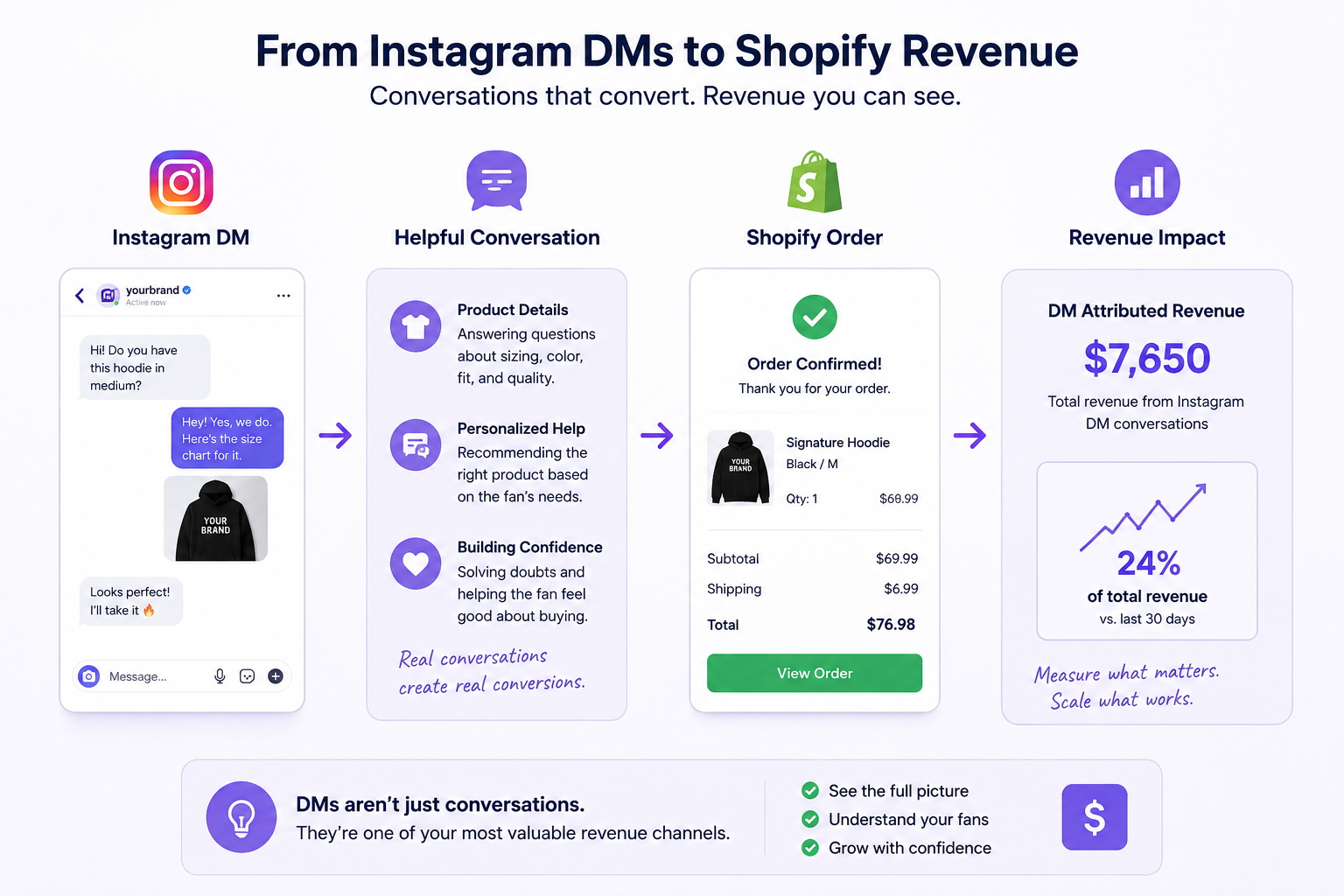
This is why DMs should not always be looked at as just an engagement channel. For some businesses or brands, especially creator-led, boutique, or higher-consideration stores, the conversation itself can be part of the sales process.
Before you can improve that process, you need to be able to see it.
Why DM Revenue Is Becoming a Critical Metric for Shopify Founders
DM revenue can tell you something that DM volume cannot.
Knowing that your brand received 10,000 DMs does not tell you whether those conversations helped generate $500 or $50,000 in sales.
The revenue number gives you more context.
Channel Dependency
If a large part of your revenue comes from conversations, DMs are probably doing more than answering customer questions.
They may be helping customers decide what to buy, understand a product, compare options, or feel confident enough to place an order.
That tells you something about how people actually buy from your store.
Scalability
There is also another side to it.
A high amount of DM-driven revenue can be a good sign. It can mean customers value the help they get before buying.
But if every conversation needs to be handled manually, that process can become difficult to scale.
More customers can mean more questions, more replies, and more time spent in the inbox.
So DM revenue can show both an opportunity and a possible operational challenge.
Attribution Blind Spots
The third issue is attribution.
A customer might discover a product on Instagram, talk to the brand in DMs, and then finish the purchase through Shopify.
If those interactions are not connected properly, the founder may see the order but not the full journey behind it.
That makes it harder to know how much value the DM channel is actually creating.
What Percentage of Shopify Revenue Comes From Instagram DMs?
There is no single percentage that every Shopify store should aim for.
And that is important.
A store selling simple products that customers can easily understand may have very little need for DMs before a purchase.
A creator-led store might be completely different. Customers may want to ask about sizing, availability, product differences, restocks, or what the creator recommends.
The buying journey is different, so the percentage can be different too.
A low DM revenue percentage is not automatically a bad thing. It could simply mean that customers can purchase without much assistance.
A high percentage is not automatically good either. It could mean that conversations are helping customers convert, but it could also mean the business depends heavily on manual conversations.
So instead of asking
“What percentage should I have?”
the more useful question is
“What does my percentage tell me about how my customers buy?”
Why Shopify Analytics Alone May Not Show the Full DM Revenue Picture
Shopify already provides marketing attribution reports and several attribution models, including last click, first click, last non-direct click, any click, and linear attribution. These models can give different views of the same customer journey.
That is useful, but a DM-to-purchase journey can still be difficult to understand.
Imagine someone:
- Finds your brand on Instagram.
- Sends a DM.
- Asks about a product.
- Gets help choosing the right option.
- Leaves Instagram.
- Visits your Shopify store.
- Places an order.
The final order happens at your store.
The conversation happened somewhere else.
That creates a gap between the conversation and the transaction.
The same issue can come up when customers receive information through DMs but later return directly to the website, use a different device, or purchase without using a trackable discount code.
The result is that a founder may know where the order was completed without knowing everything that happened before the checkout.
This is why conversation-to-order attribution matters.
How Founders Currently Estimate DM Revenue
When there is no clear connection between conversations and orders, founders usually have to find another way to estimate it.
Manual Order Tagging
One option is to tag an order or customer after a DM conversation leads to a purchase.
This can work when the number of conversations is small.
But it relies on someone remembering to do it every time.
Once the inbox gets busy, things can easily be missed.
Discount Codes
Another common method is giving customers a unique discount code through Instagram.
This makes it easier to identify some purchases that came from DMs.
But it only works when the customer actually uses the code.
A customer might get the code, remember the product, and come back later to buy without entering it.
That sale would then be missed.
Asking Customers
Brands can also ask customers how they found the product or whether someone helped them before buying.
This can give you useful feedback, but it is still based on what the customer remembers and chooses to report.
It also does not give you a clean conversation-to-order connection.
Spreadsheets and Manual Audits
Some founders compare conversations, customer information, order notes, and timestamps manually.
That might be fine for a small number of conversations.
It becomes a different problem when you have hundreds or thousands of them.
Across all of these methods, the problem is similar: they can give you an estimate, but they are difficult to keep accurate as the business grows.
SentLogic Turns DM Conversations Into a Revenue Signal
This is where SentLogic fits into the picture.
Instead of looking at DMs only as conversations or engagement, SentLogic helps founders understand how those conversations connect with revenue outcomes.
The question changes from
“How many DMs did we receive?”
to
“Which conversations contributed to revenue?”
That difference matters.
If a founder can see which conversations are connected to purchases, they can start looking at what happens inside those conversations.
Are customers asking about certain products?
Are certain questions appearing before purchases?
Are some conversations much more likely to lead to an order?
The point is not to create another number just for the sake of reporting. It is to give founders a clearer view of what is happening between the first conversation and the final purchase.
And this is where LogI can become useful as well.
LogI is SentLogic’s agentic AI for handling conversations. Through LogI Studio, creators and brands can configure how LogI communicates, what role it plays, how it handles sales conversations, how it uses CTAs, and what product information it can access through the Knowledge Base.
That means the same conversation channel that is being measured can also be managed more effectively.
For example, LogI can respond to product questions, help customers with common questions, recommend relevant products, and handle conversations based on the information available to it.
The goal is not simply to automate DMs.
It is to understand the revenue happening inside those conversations and then make it easier to manage them as the business grows.
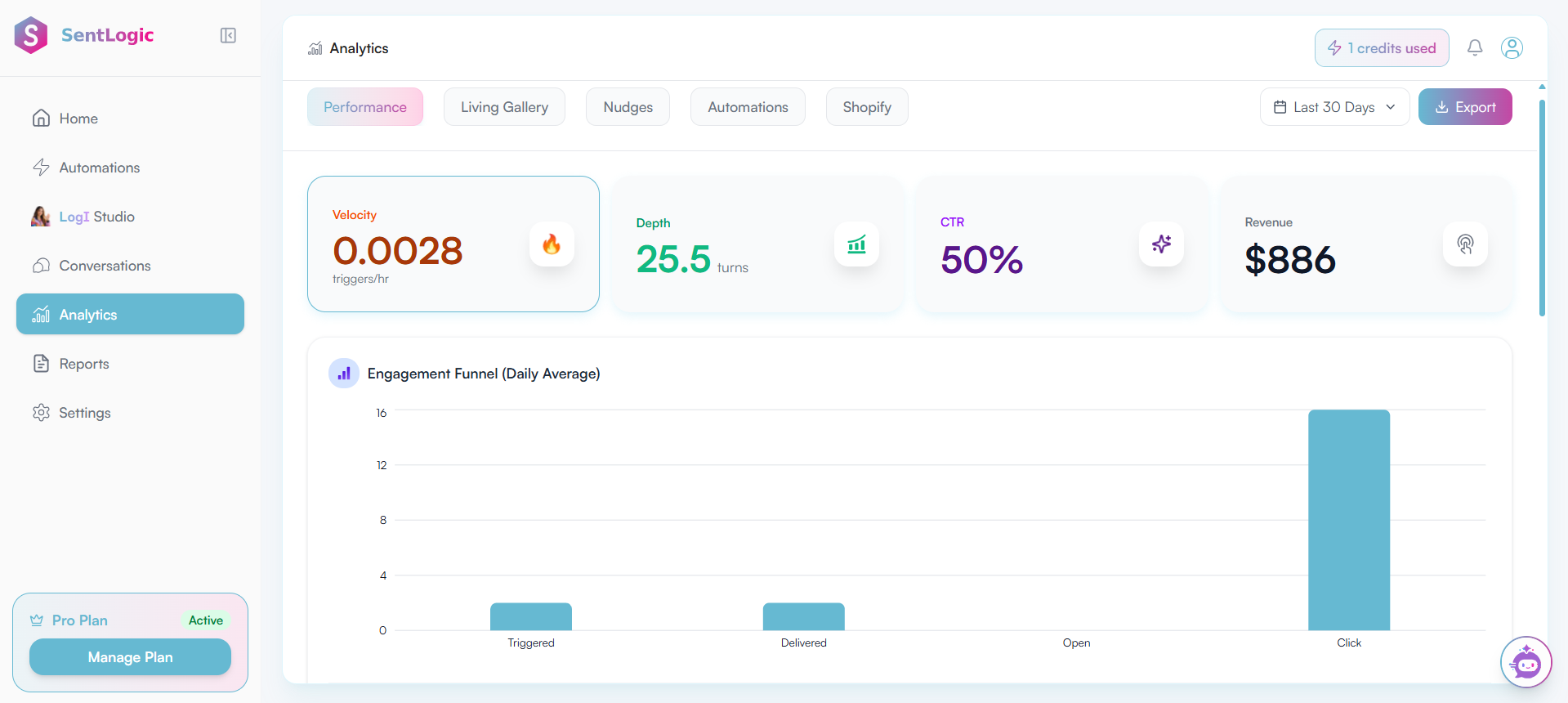
How to Calculate Your DM Revenue Percentage
The actual calculation is simple.
DM Revenue Percentage = DM Attributed Revenue ÷ Total Shopify Revenue × 100
For example, imagine your Shopify store made $100,000 in revenue in one month.
If $15,000 was attributed to Instagram conversations:
$15,000 ÷ $100,000 × 100 = 15%
Your DM revenue percentage would be 15%.
The difficult part is not the calculation.
It is deciding what should count as DM-attributed revenue in the first place.
Your DM revenue and total Shopify revenue should also come from the same time period. Comparing DM revenue from one month with total revenue from another can give you a misleading number.
The attribution method matters more than the formula.
What Your DM Revenue Percentage Reveals About the Business
A Low Percentage Can Still Be a Useful Signal
A low percentage does not automatically mean that Instagram DMs are not useful.
If customers can easily understand your products and complete a purchase without needing help, there may simply be less reason for them to start a conversation.
That can be perfectly normal.
The number can still help you understand whether there are parts of the buying journey where a conversation could make a difference.
A High Percentage Can Reveal Both Opportunity and Dependency
A high percentage can show that conversations are playing a major role in sales.
This can be especially important for creator-led brands, boutique stores, and products where customers want more information before buying.
But there is another question to ask:
Can the business handle that level of conversation as it grows?
If a large share of revenue depends on someone answering questions, recommending products, and handling objections manually, the same thing that is driving revenue can eventually become a bottleneck.
The Number Is a Business Signal, Not a Score
There is no point trying to push the percentage higher just because a higher number sounds better.
The number is useful because it tells you something about your business.
A store where 5% of revenue comes from DMs and another where 40% comes from DMs may both be doing well.
They simply have different customer journeys.
The important thing is understanding what your own number means.
When DM Revenue Becomes a Scalability Question
Once DMs start contributing a meaningful amount of revenue, the next question is how you manage that volume.
A customer might need help choosing a size.
Another might ask when a product will restock.
Someone else might want to compare two products.
Another customer may be ready to buy but have one last question.
A person can handle a few conversations like these without much trouble.
Hundreds or thousands are different.
This is where DM revenue becomes a scalability question.
If you know that conversations are generating an important share of your revenue, you also need to think about how to handle those conversations without making the whole process depend on manual replies.
That is one area where LogI can play a role.
With LogI Studio, the creator or brand can set up the AI Role, choose the Response Tone, define the Sales Approach, set the CTA Style, and add relevant product information through the Knowledge Base.
The setup is meant to give LogI enough context to handle conversations in a way that fits the brand instead of responding like a generic customer service bot.
The Knowledge Base can give LogI the information it needs about products, while the Role and other settings help shape how it communicates.
That means the focus can move from simply answering more DMs to handling conversations in a way that supports the customer journey.
And because the conversations can be connected back to revenue, founders have a better way to understand whether that process is actually working.
Conclusion
So, what percentage of your Shopify revenue comes from DMs?
It is a simple question, but many founders still cannot answer it clearly.
The problem is usually not the formula.
The problem is connecting what happens in the conversation with what happens at checkout.
A customer can ask questions on Instagram, get help from a brand, and then purchase through Shopify.
If those parts of the journey are not connected, the revenue can look like a normal Shopify order even when the conversation played an important role.
There is also no single percentage that every Shopify business should aim for.
A low number can make sense for one store. A high number can make sense for another.
What matters is knowing your own number and understanding what it tells you about the way customers buy.
SentLogic helps make that connection clearer by linking DM conversations with revenue outcomes.
And when those conversations become a bigger part of the business, LogI and LogI Studio can help brands manage them at scale, with the creator's role, communication style, sales approach, CTA style, and product information all working together.
The real value is not simply knowing that DMs generate revenue.
It is knowing how much they generate, what those conversations are doing, and what you can do with that information next.
Frequently Asked Questions
What Percentage of Shopify Revenue Typically Comes From Instagram DMs?
There is no standard percentage that applies to every Shopify store. It depends on the products, business model, and how much customers rely on conversations before buying.
The most useful number is your own DM-attributed revenue percentage and what it tells you about your customer journey.
Why Doesn't Shopify Analytics Show DM Attributed Revenue Clearly?
Shopify provides several attribution models for understanding marketing interactions and sales. However, a customer can start their journey in an Instagram DM and complete the purchase later through a normal Shopify checkout.
If the conversation and order are not connected, it can be difficult to see the full role the DM played in the purchase
How Do I Calculate What Percent of My Revenue Comes From DMs?
Use the formula:
DM Revenue Percentage = DM Attributed Revenue ÷ Total Shopify Revenue × 100
Make sure both numbers cover the same time period and use the same attribution method.
What Counts as DM Attributed Revenue?
DM attributed revenue is any revenue that you can tie to a customer chat. This depends entirely on what kind of attribution system you are using, but the critical factor here is consistency. Using multiple definitions for different reports isn't going to help.
Is a High DM Revenue Percentage a Good or Bad Sign?
Both.
Having a higher ratio could indicate that chat interactions play an essential role in driving purchases. On the other hand, having a lower percentage might suggest that there isn't as much reliance on manual conversations and that purchases can be made with minimal support.
Numbers are always more helpful once they've been put into context.
Related Articles



No setup fees · Cancel anytimeStop losing leads and
Stop losing leads and
repeating order updates.
Join thousands of brands using LogI to automate, optimize, and scale their Instagram DM sales, effortlessly.
Loved by 800+ sellers · 4.9 ★ on Trustpilot
Start Growing With the LogI