
What a 3-Month Free Pro Trial Actually Shows a Shopify Founder About Their Own DM Revenue
Sep 29, 202613 min read
Most Shopify founders already have a feeling that Instagram DMs are driving sales. A customer asks about sizing, checks whether a product is back in stock, wants help choosing between two products, and then disappears for a while before placing an order.
The problem is not whether those conversations happen. The problem is knowing what they are actually worth.
A few days of data can show activity. Three months can show a pattern.
A 3-month Pro trial gives a Shopify founder enough time to observe real conversations, connect them with Shopify purchases, measure how often conversations lead to orders, and calculate the revenue associated with those conversations. Instead of asking whether Instagram DMs might be contributing to sales, the founder can start answering that question using data from their own store.
This guide looks at what that three-month period can actually reveal, what to measure along the way, and how to turn the resulting conversation and order data into a clear picture of Instagram DM revenue and ROI.
What Does a Shopify Founder Need to Set Up Before the Trial Starts?
The first step is making sure the accounts and data needed for revenue tracking are connected before the trial begins. For a Shopify founder, that means connecting the Shopify store and Instagram account and setting up the revenue tracking and attribution model.
The connection itself is designed to be quick, with account connection taking under 30 seconds. Once the relevant accounts are connected, the founder can begin collecting conversation data alongside Shopify order information.
Starting with this foundation matters because the goal of the trial is not simply to count Instagram conversations. It is to eventually understand what happens after those conversations and whether they contribute to purchases.
The cleaner the starting point, the easier it becomes to compare what happens during month one, month two, and month three.
What Should a Shopify Founder Measure During the 3-Month Trial?
A founder evaluating Instagram DM revenue needs to look beyond the number of messages received. Conversation volume shows activity, but it does not tell you whether those conversations are contributing to sales.
Several measurements can help build that picture.
The conversation-to-Purchase Rate shows the percentage of measured conversations that result in purchases.
Revenue from DM Conversations shows the Shopify revenue generated from purchases that can be connected to Instagram DM conversations. This helps founders understand the financial contribution of conversations rather than looking only at how many DMs they received.
Attributed Shopify Revenue shows the actual dollar value of Shopify orders that are connected to measured Instagram conversations. It gives the founder a clearer view of how much revenue can be linked back to the DM customer journey.
Average Order Value shows the average amount customers spend when they make a purchase associated with these conversations. This helps put the revenue into context and can reveal whether DM-driven customers are generating smaller or larger orders.
Instagram DM ROI compares the revenue associated with Instagram DM conversations against the cost of managing the channel. This helps founders determine whether the revenue generated from their DM activity justifies the cost involved.
For example, the conversation-to-purchase rate can be calculated as
Purchases ÷ DM conversations × 100
The important point is that the complete numerical example belongs later in the calculation section. At this stage, the founder is establishing which numbers need to be watched and why they matter.
Together, these measurements can turn an Instagram inbox from a simple activity channel into something that can be evaluated in financial terms.
How Can a Shopify Founder See Which Instagram Conversations Lead to Shopify Revenue?
The useful question is not simply whether someone sent a DM and later bought something. It is whether the conversation can be connected to the customer and the eventual Shopify order.
The journey can be viewed as the following:
Instagram DM to Customer to Shopify Order to Revenue
The conversation captures the interaction. The customer connects that interaction to the shopper. The Shopify order shows whether a purchase happened. Revenue shows the financial outcome.
SentLogic's Conversations view gives the founder a clearer picture of what is happening within those individual interactions. Instead of treating every DM as the same, conversations can be surfaced based on signals such as Hot Leads, sales intent, LogI confidence, and whether a conversation needs human attention.
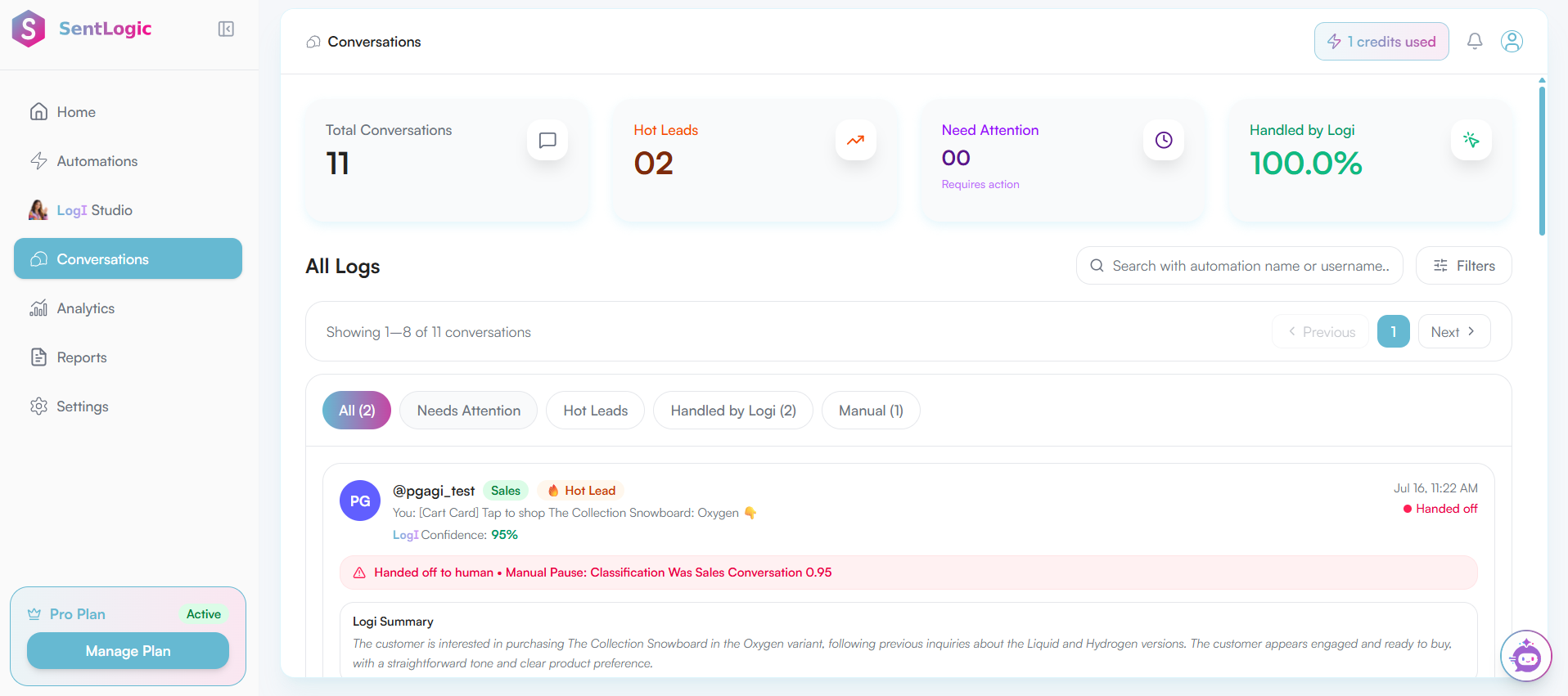
Consider a customer who messages a clothing brand about the sizing of a jacket. The founder uses LogI to help answer the question. The customer does not purchase immediately. Several days later, that customer returns to the Shopify store and completes the order.
Looking only at the Shopify order shows that a purchase happened. Looking only at the Instagram inbox shows that a conversation happened. Connecting the two provides a much clearer picture of what happened between the first interaction and the final purchase.
The conversation view helps establish the first part of that journey by showing what happened inside the DM and what signals were present before the purchase. When that conversation data is connected with Shopify order data, the founder can move beyond simply seeing conversations and start understanding which conversations contribute to Shopify revenue.
That connection is what makes conversation-to-order attribution useful; it gives founders a way to trace the path from an Instagram interaction to a customer and, ultimately, to the revenue associated with the resulting Shopify purchase.
That connection is what allows a founder to move from simply seeing conversations to understanding which conversations contribute to Shopify revenue.
What Can a Shopify Founder Learn in the First Month?
The first month is primarily about establishing a baseline.
Instead of immediately deciding whether Instagram DMs are valuable, a founder can start by observing what is actually happening inside the inbox.
How many conversations are taking place? What types of conversations are appearing? How frequently do conversations lead toward a purchase? What does the initial Conversation-to-Purchase Rate look like?
Early data can also reveal patterns that would otherwise remain anecdotal. A founder may discover that certain conversations repeatedly appear before purchases, while others rarely progress beyond the initial interaction.
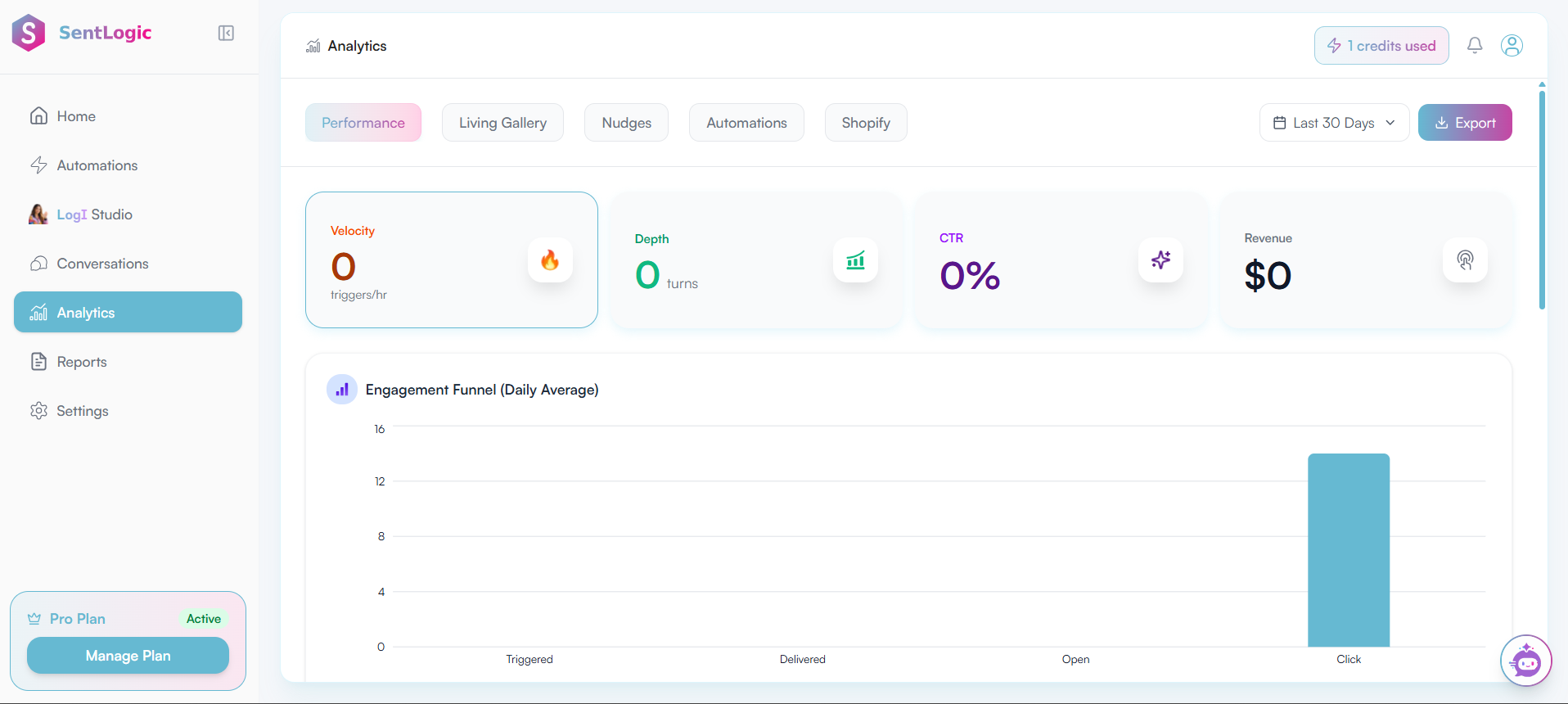
The first month therefore provides a starting point for comparison. It is less about reaching a final conclusion and more about understanding what the founder's own data looks like before making broader decisions.
The Analytics view brings key conversation performance signals into one place, including Velocity, Depth, CTR, and Revenue. This gives the founder an initial picture of how Instagram conversations are performing during the trial.
What Changes by Month Two of the Trial?
By the second month, there is more data to compare against the initial baseline.
Instead of looking at individual conversations in isolation, a founder can begin identifying recurring patterns. Certain questions may appear frequently. Some customer interactions may be associated with stronger purchase intent. Others may require more information before a customer is comfortable buying.
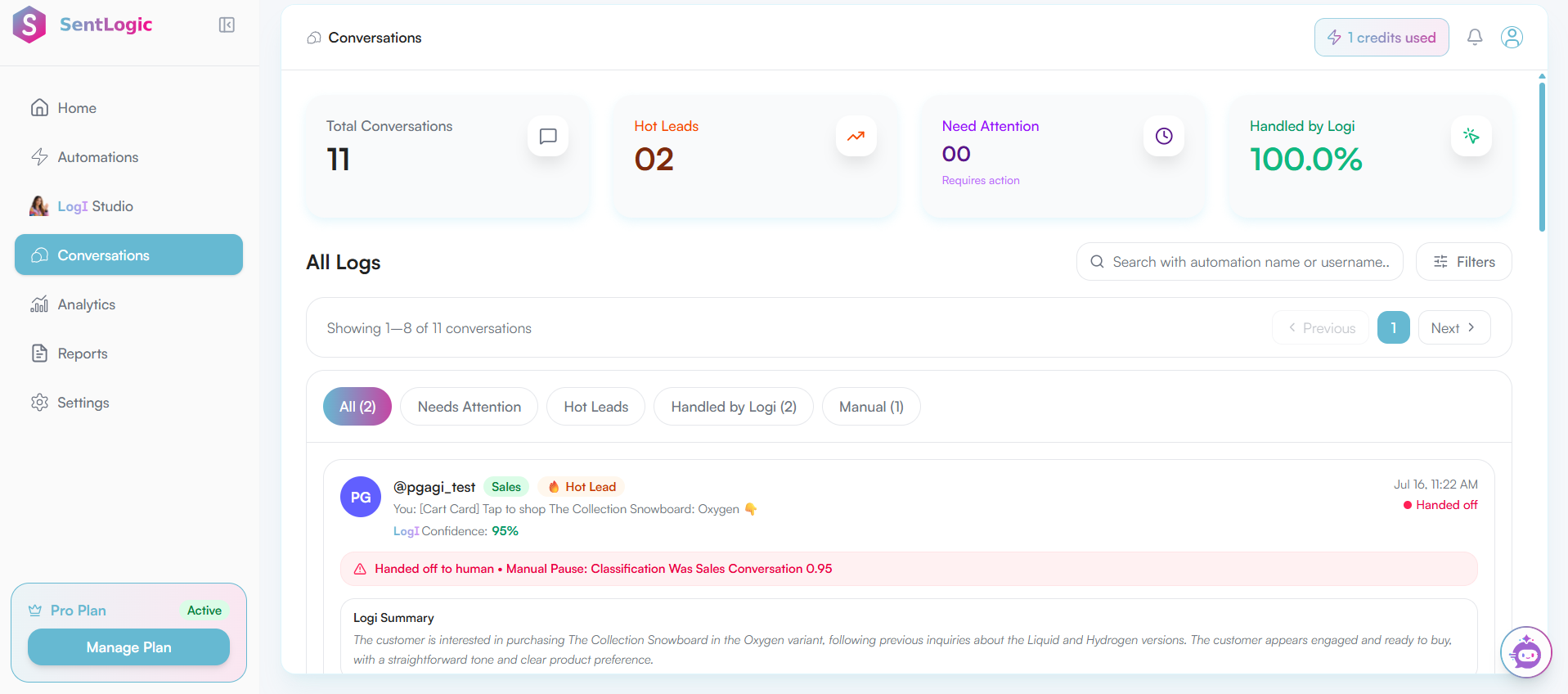
The Conversations view can help make these patterns easier to identify. For example, the dashboard highlights Hot Leads, shows whether conversations are being handled by LogI or require human attention, and provides a LogI confidence score for individual interactions.
This is also where repetitive interactions can become easier to manage. If customers repeatedly ask the same questions, appropriate automation can reduce response delays and make those interactions more efficient.
Conversation patterns can also help reveal where customers need clearer product information or guidance. Over time, these observations can inform how products are presented and how customers are guided through conversations.
The focus shifts from simply observing the inbox to understanding what the growing body of conversation data is telling the business.
What Can a Shopify Founder Prove by Month Three?
By month three, the founder has something much more useful than a short-term snapshot.
There is now enough time to compare conversations, purchases, and revenue across multiple months and look for consistency.
The founder can evaluate whether Instagram conversations are repeatedly contributing to Shopify purchases rather than relying on a handful of individual examples.
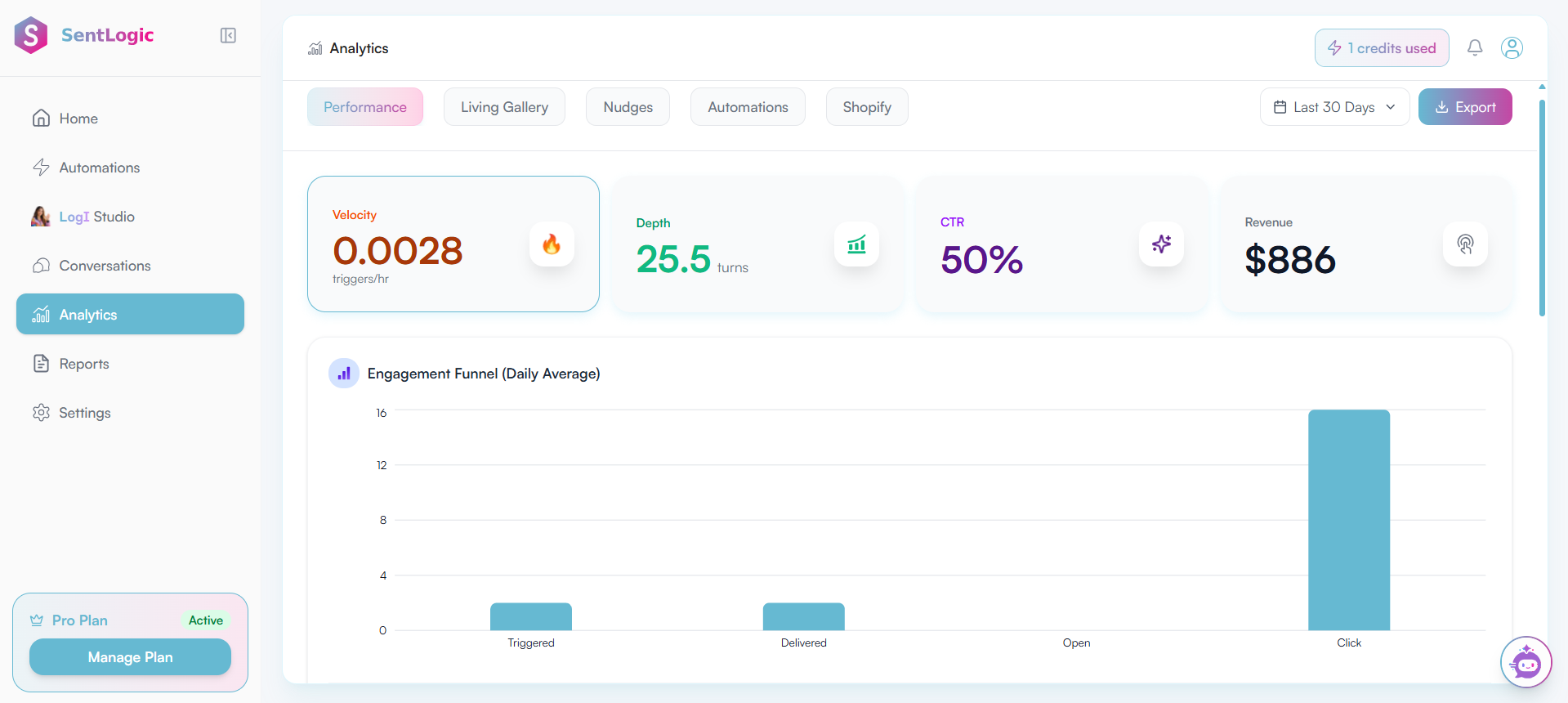
With this longer view, the founder can establish a more reliable conversation-to-purchase rate, measure the revenue associated with attributed purchases, and compare that revenue against the cost of managing the channel.
They can establish a more reliable conversation-to-purchase rate, measure the revenue associated with attributed purchases, and compare that revenue against the cost of managing the channel.
Most importantly, the founder can move from saying, "I think our Instagram DMs are driving sales," to having store-specific evidence that shows how those conversations are contributing to the business.
That distinction matters when deciding whether continued investment in the channel makes financial sense.
How Do You Calculate Instagram DM Revenue and ROI?
Once the three months of data are available, the founder can use the numbers to calculate the financial value of Instagram conversations.
Consider an illustrative example for a US DTC Shopify brand.
Over the measured period, the brand records the following:
- 500 Instagram DM conversations
- 50 purchases associated with those conversations
- $4,000 in attributed Shopify revenue
- $300 in monthly costs associated with managing the channel
Step 1: Calculate the Conversation to Purchase Rate
The formula is
50 purchases ÷ 500 conversations × 100 = 10%
The conversation-to-purchase rate is therefore 10%.
Step 2: Calculate Instagram DM Revenue
The purchases associated with the measured conversations generated $4,000 in attributed revenue
That is the revenue figure the founder can use when evaluating the financial contribution of Instagram DMs.
Step 3: Calculate Instagram DM ROI
If the associated monthly cost is $300, the ROI calculation is
($4,000 − $300) ÷ $300 × 100 = 1,233%
The resulting Instagram DM ROI is approximately 1,233%.
The example uses illustrative store-level figures to show how the calculation works. Actual Instagram DM revenue and ROI will vary based on factors such as conversation volume, purchase rate, average order value, customer intent, and attribution accuracy.
The value of the three-month trial is that the numbers can come from the founder's own store rather than from a generic industry benchmark.
What Should a Shopify Founder Decide at the End of the Trial?
At the end of three months, the founder should be able to answer several practical questions.
- Are Instagram conversations consistently contributing to purchases?
- What percentage of measured conversations result in orders?
- How much Shopify revenue can be associated with those conversations?
- How does that revenue compare with the cost of managing the channel?
- And perhaps most importantly, is the financial contribution large enough to justify continued investment?
The purpose of the trial is therefore not simply to decide whether the platform was useful. It is to give the founder enough evidence to make a business decision.
How Can Shopify Founders Get More Revenue Value From the Trial?
The value of the trial does not stop at calculating a revenue number.
Once conversation data begins showing patterns, founders can give stronger purchase intent conversations more attention and use the information from those interactions to improve future customer experiences.
Instead of treating every DM as identical, the founder can start identifying which conversations appear closer to a purchase and where customers need more information before making a decision.
The data can also help inform decisions about time and resource allocation. If the inbox is consistently contributing meaningful revenue, understanding that contribution can help a founder decide how much attention the channel deserves.
The goal is to move from simply measuring conversations to using what those conversations reveal to make better revenue decisions.
How Does SentLogic Turn the Pro Trial Into Revenue Proof?
SentLogic helps connect Instagram conversations with Shopify orders and revenue, giving founders a way to evaluate the financial impact of their Instagram inbox using data from their own business.
During the trial, the founder can first see what is happening inside the inbox through the Conversations view. It brings together signals such as Total Conversations, Hot Leads, Need Attention, and conversations Handled by LogI. This gives the founder a clearer picture of conversation volume and which interactions may require attention, without having to piece the information together manually.
The founder can then move from individual conversation activity to broader performance data through Analytics. The Performance view brings metrics such as Velocity, Depth, CTR, and Revenue into one place, making it easier to monitor how Instagram activity is performing as the trial progresses
As conversation and order data builds over the three-month period, the founder can move beyond individual interactions and start evaluating broader patterns in conversation-driven revenue.
The result is a more practical way to answer the question that matters at the end of the trial: How much revenue are my Instagram DMs actually contributing to my business?
How Can a Shopify Founder Start the Trial?
Getting started with SentLogic takes under 30 seconds. Connect your Shopify store and Instagram account, and the three-month trial window can begin working with your real conversation and order data.
Start with one clear question: What are my Instagram DMs actually worth to my business?
From there, the three-month period provides the time needed to establish a baseline, compare patterns, measure purchases, calculate attributed revenue, and evaluate ROI.
The important part is to treat the trial as a measurement period from the beginning. The more consistently the founder reviews the data, the more useful the final revenue picture becomes.
Start your SentLogic Pro trial: https://www.sentlogic.com/
Conclusion
A three-month Pro trial can show a Shopify founder something that Instagram DM activity alone cannot connect: the financial contribution of conversations to the business.
By measuring conversations, connecting them with Shopify purchases, calculating the Conversation to Purchase Rate, and evaluating attributed revenue and ROI, a founder can replace assumptions with evidence from their own store.
The result is not a guaranteed revenue number. It is something more useful for a business decision: a store-specific view of what Instagram DMs are actually contributing.
For founders who already suspect that their Instagram inbox is influencing sales, three months provides the opportunity to finally put a number behind that feeling.
Frequently Answered Questions
How long does it take to start seeing useful DM revenue data?
The account connection takes under 30 seconds. From there, the value comes from allowing enough time for real conversations and Shopify purchases to accumulate so the founder can identify meaningful patterns and build a clearer picture of DM-driven revenue.
How much Instagram DM revenue can a Shopify founder see during the trial?
There is no fixed revenue amount because results depend on the store's conversation volume, purchase rate, average order value, and customer intent. The purpose of the trial is to measure the revenue associated with the founder's own Instagram conversations.
What should I measure during a Shopify free trial?
A founder evaluating Instagram DM revenue should look at conversation volume, conversation-to-purchase rate, attributed Shopify revenue, average order value, and ROI. Together, these measurements provide a clearer view of the financial contribution of Instagram conversations.
How do I track Instagram DM revenue on Shopify?
Instagram DM revenue can be tracked by connecting Instagram conversation data with Shopify order data and identifying which conversations contribute to purchases. SentLogic helps make this connection measurable so founders can evaluate the revenue impact of their Instagram inbox.
What happens to my data after the SentLogic trial ends?
The trial gives the founder time to collect and evaluate their own conversation and order data before deciding whether to continue. The key outcome of the trial is having a clearer understanding of the revenue contribution of Instagram DMs and whether continued investment makes sense.
Related Articles



No setup fees · Cancel anytimeStop losing leads and
Stop losing leads and
repeating order updates.
Join thousands of brands using LogI to automate, optimize, and scale their Instagram DM sales, effortlessly.
Loved by 800+ sellers · 4.9 ★ on Trustpilot
Start Growing With the LogI